How Plumbing Businesses Can Capture More Service Requests with AI
Missed plumbing inquiries can mean missed business opportunities. Discover how AI-powered messaging helps plumbing companies respond after hours, collect customer details, understand photos, and organize service requests while keeping employees in control.
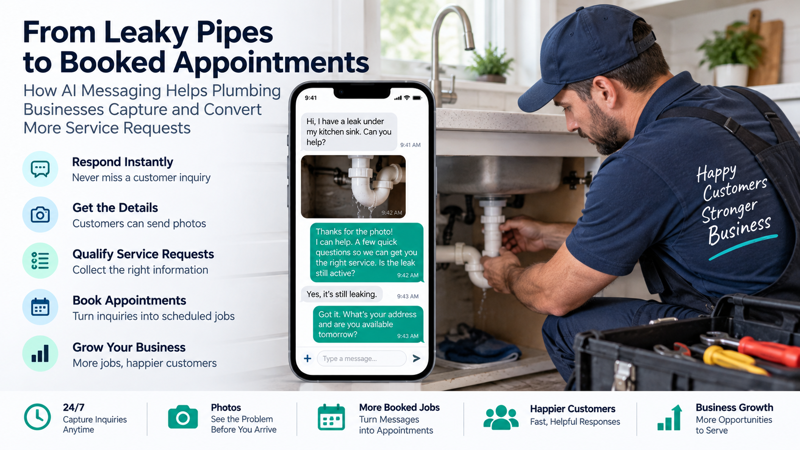
A homeowner discovers a leaking pipe at 9:30 PM. Another customer needs a water heater replaced but cannot call during business hours. Meanwhile, a property manager sends several maintenance requests while your plumbers are busy on other jobs.
For plumbing companies, customer inquiries rarely arrive at convenient times.
The challenge is not simply answering the phone. It is capturing the right information, identifying urgent situations, and making sure every legitimate service request reaches the appropriate employee.
AI-powered customer messaging can help plumbing businesses manage these situations without requiring someone to manually respond to every routine inquiry.
Why Plumbing Businesses Lose Service Opportunities
Plumbing companies often operate with small teams. Technicians spend much of their day traveling, diagnosing problems, performing repairs, and speaking with customers.
During busy periods, several communication problems can arise:
Customers send messages outside normal business hours.
Employees cannot immediately respond while working.
Important details are scattered across text conversations.
Customers must repeat information when speaking with another employee.
Potential jobs are forgotten or followed up too late.
A customer requesting an estimate may contact several plumbing companies. The business that responds promptly and professionally has a better opportunity to earn the customer's trust.
However, responding quickly is only the beginning. The business must also understand what the customer needs.
How AI Helps Capture Plumbing Service Requests
AI-powered messaging allows customers to describe their problems naturally through text.
Instead of navigating a complicated form, someone might write:
"My kitchen sink has been leaking underneath for two days. Can someone come tomorrow?"
An AI-assisted system can recognize useful details such as the service category, problem description, and requested appointment timeframe.
It can then ask relevant follow-up questions.
For example:
"Is the leak continuous, or does it happen only when you use the sink?"
This creates a more organized inquiry before an employee becomes involved.
1. Respond to Inquiries Outside Business Hours
Many plumbing problems happen during evenings and weekends.
A messaging system that operates outside regular business hours can acknowledge supported customer inquiries and collect useful information.
For example, a customer might send:
"Our water heater stopped producing hot water. Do you service this area?"
The system can help determine whether the request falls within the plumbing company's configured services and coverage area.
Important: An automated acknowledgement is not a guarantee of immediate technician availability.
The business remains responsible for confirming appointments and service commitments.
2. Collect Information Before Dispatching a Technician
Incomplete service requests create unnecessary follow-up work.
For plumbing businesses, useful qualification details may include:
Customer name and contact information.
Property or service location.
Type of plumbing problem.
When the problem started.
Whether water is actively leaking.
Preferred service timeframe.
Relevant photographs.
Having this information organized helps employees understand the request before contacting the customer.
It can also reduce repeated questions and improve internal coordination.
3. Use Customer Photos to Understand Plumbing Problems
Photographs can provide valuable context.
A homeowner might send a picture of a leaking faucet, damaged pipe, water heater label, or unusual plumbing connection.
AI image understanding can help identify visible features and support follow-up questions.
For example, a photo might suggest that a faucet is leaking near its handle or that water is collecting beneath a sink.
However, AI image analysis is not a substitute for a professional plumbing inspection.
Photographs cannot reliably establish the condition of hidden pipes, internal components, water pressure, or the complete cause of a failure.
The purpose is to help the business gather context—not provide an unsupported diagnosis.
4. Identify Urgent Requests for Human Attention
Not all plumbing inquiries have the same urgency.
Compare these situations:
Routine inquiry: "I'd like an estimate to replace my bathroom faucet next month."
Potentially urgent inquiry: "Water is spraying from a broken pipe, and I cannot stop it."
The second situation requires more immediate attention.
AI can help recognize language indicating urgency and support escalation according to the business's configured procedures.
Nevertheless, businesses should not rely exclusively on AI to assess safety-sensitive situations.
Customers facing immediate hazards should be directed toward appropriate emergency assistance, and the business should establish clear procedures for urgent requests.
5. Organize Requests for Employees
Capturing an inquiry is valuable only if employees can act on it.
A structured customer request may include the service description, customer details, urgency indicators, and preferred follow-up time.
Instead of searching through disconnected messages, staff can review the information in one place.
This helps plumbing businesses coordinate estimates, follow-up conversations, and service planning.
6. Reduce Repetitive Administrative Work
Plumbing companies regularly answer similar questions:
"Do you repair water heaters?"
"Do you serve my ZIP code?"
"Can I request an estimate?"
"Are you available on weekends?"
AI-powered messaging can help answer supported questions using the company's configured business information.
This allows employees to spend less time on repetitive intake tasks and more time helping customers with issues requiring human judgment.
Example: From Customer Message to Organized Plumbing Request
Consider a homeowner who texts a plumbing company:
"My bathroom sink is leaking, and I think the pipe underneath is damaged."
A practical AI-assisted intake process might look like this:
Step 1 — Initial inquiry
The system receives the message and recognizes a potential plumbing service request.
Step 2 — Qualification
The AI asks relevant questions about the leak, location, and urgency.
Step 3 — Photo collection
The customer sends a photograph of the area beneath the sink.
Step 4 — Information organization
The system associates the description and available image information with the customer's request.
Step 5 — Employee review
A plumbing employee reviews the details and determines the appropriate next action.
Step 6 — Appointment confirmation
The business confirms availability and any actual service appointment.
This approach can make the initial communication more efficient without removing professional judgment from the process.
AI Messaging vs. Traditional Plumbing Intake
Capability | Traditional manual intake | AI-assisted messaging |
|---|---|---|
After-hours text inquiries | Requires staff availability | Can operate automatically |
Initial customer questions | Employee handles individually | AI can collect routine details |
Customer photos | Reviewed manually | AI can help interpret visible details |
Organizing request information | Often manual | Can be structured automatically |
Human decision-making | Direct | Still required when appropriate |
Confirming service appointments | Staff responsibility | Depends on configuration and approval rules |
AI-assisted messaging is particularly useful for plumbing businesses that receive frequent inquiries but cannot dedicate an employee to monitoring messages continuously.
It does not eliminate the need for skilled technicians, customer service employees, or business oversight.
How Zeerek Service Supports Plumbing Businesses
Zeerek Service is designed to help service businesses manage customer inquiries using AI-powered SMS/MMS communication and organized workflows.
For plumbing companies, its supported capabilities include:
AI-powered customer qualification: Collect relevant information through natural text conversations.
Photo understanding: Help interpret customer-submitted plumbing images while preserving the need for professional diagnosis.
Service-specific configuration: Use the plumbing company's configured services, business hours, and service areas.
Project Request management: Organize customer inquiries and associated details for employee follow-up.
Human handoff: Allow staff to take control when a conversation requires personal attention.
After-hours messaging: Continue supported customer intake outside ordinary business hours, subject to subscription allowances and operational policies.
Zeerek Service also supports telephone consent collection and call forwarding. Its current AI conversations are messaging-based, not live conversational AI voice answering.
The goal is to help plumbing companies capture and organize opportunities while keeping employees responsible for actual service decisions.
What Should Plumbing Companies Look for Before Subscribing?
Before choosing an AI communication platform, plumbing businesses should evaluate several practical questions.
Does the system understand ordinary customer messages? Can customers send photos? Does it preserve information when a conversation requires human attention? Can staff review customer requests easily?
Pricing transparency is equally important.
Businesses should understand their monthly communication allowances, what happens when limits are exhausted, and whether additional usage requires payment.
A reliable system should make these policies clear rather than surprise customers with unexpected charges.
Final Thoughts
Plumbing businesses don't necessarily need more complicated software.
They need a dependable way to respond to customer inquiries, collect useful details, organize potential jobs, and reduce unnecessary administrative work.
AI-powered messaging can support these goals when it is designed around real service-business operations.
By combining automation with human oversight, plumbing companies can improve customer communication without sacrificing professional judgment.
Want to see how AI-assisted messaging could support your plumbing business?
Explore Zeerek Service to learn about its customer communication and service-request management capabilities.