How Much Business Do HVAC Companies Lose From Missed Calls?
Every missed HVAC call could be a lost service opportunity. Learn how to estimate the impact and improve customer follow-up.
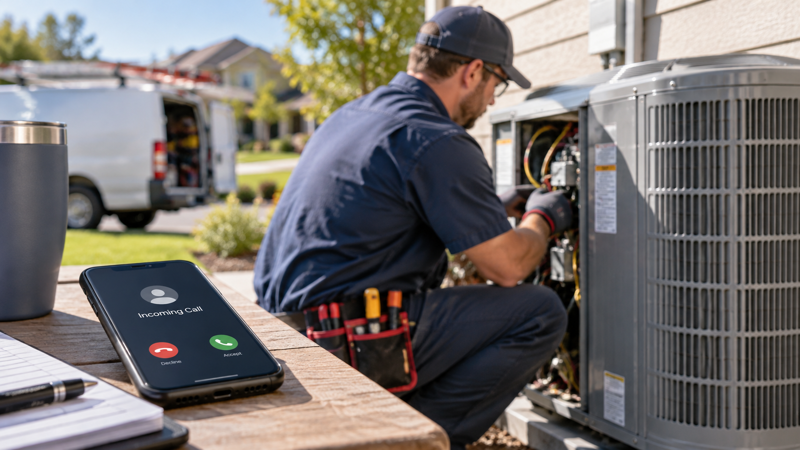
For an HVAC business, every incoming call represents a potential customer relationship. Whether someone needs emergency air conditioning repair, a furnace inspection, or an estimate for a replacement system, the first phone call is often the beginning of a valuable service opportunity.
But what happens when nobody answers?
The customer might leave a voicemail, call again, or simply contact another HVAC contractor. During busy seasons, when technicians are working in the field and office staff are overwhelmed, unanswered calls can quietly become an expensive operational problem.
The good news is that HVAC companies can measure this problem, estimate its financial impact, and implement practical solutions without necessarily hiring additional full-time receptionists.
Why Missed Calls Matter in the HVAC Industry
HVAC service requests are frequently time-sensitive. A homeowner whose air conditioner stops working during extreme summer heat may not want to wait several hours for a callback.
Missed calls are particularly problematic when:
Technicians are working on customer equipment and cannot answer.
Office employees are already assisting other customers.
Calls arrive outside normal business hours.
Seasonal demand increases unexpectedly.
Small contractors operate without dedicated reception staff.
Customers need immediate confirmation that their inquiry was received.
Research discussed by ServiceTitan indicates that unanswered calls remain a significant challenge for home-service businesses, particularly outside standard business hours.
However, not every missed call represents a lost customer. Some callers are vendors, existing customers, or people who eventually call back. The important question is how many genuine service opportunities are not being captured.
How to Calculate the Potential Revenue Lost From Missed HVAC Calls
Rather than relying on dramatic industry-wide estimates, HVAC owners can use their own operating numbers.
Consider this hypothetical example:
Business metric | Example |
|---|---|
Incoming calls per month | 200 |
Calls unanswered | 20% |
Missed calls | 40 |
Qualified service inquiries among missed calls | 60% |
Potential booking conversion rate | 40% |
Average completed service value | $350 |
The calculation is:
40 missed calls × 60% qualified inquiries × 40% conversion × $350 average job value = $3,360 in potential monthly revenue at risk.
That represents approximately $40,320 annually if the same conditions continue for twelve months.
This is an illustrative scenario, not a claim that a typical HVAC company loses this amount.
It also does not mean every missed opportunity is permanently lost. Some customers reconnect, and some booked jobs are canceled. A more accurate calculation should account for recovered inquiries and actual completed work.
Importantly, revenue is not profit. Contractors must subtract labor, equipment, materials, travel, and other job expenses to estimate the financial benefit of recovering additional customers.
The Hidden Cost of After-Hours HVAC Inquiries
HVAC emergencies do not follow business hours.
A customer may discover a malfunctioning air conditioner late in the evening, during a weekend, or on a holiday.
Without an effective communication process, the customer may encounter an unanswered phone, an unmonitored voicemail, or a website that provides no useful next step.
For HVAC companies, an effective after-hours process should help customers:
Understand whether emergency service is available.
Explain the problem they are experiencing.
Provide their contact information and service location.
Submit a service request.
Understand when a staff member will respond.
Even when immediate scheduling is unavailable, capturing accurate customer information can give the business an opportunity to follow up.
Five Practical Ways HVAC Companies Can Reduce Missed Opportunities
1. Track Answered and Missed Calls
Start by reviewing telephone records.
Measure total incoming calls, answered calls, missed calls, abandoned calls, and callbacks. Separate business-hours activity from evenings and weekends.
This establishes a baseline for improvement.
2. Establish a Consistent Callback Process
A missed call should not disappear into an unmanaged list.
Assign responsibility for reviewing unanswered inquiries, contacting customers, and recording outcomes.
A consistent process can be more valuable than simply purchasing another communication tool.
3. Offer a Convenient Text Messaging Option
Some customers prefer communicating by text, especially when they cannot remain on the phone.
A properly configured business messaging system can help collect service descriptions, contact information, and follow-up preferences.
Automated messages should respect customer consent, applicable messaging requirements, and opt-out requests.
4. Use AI to Organize Customer Inquiries
AI-assisted messaging can help businesses gather structured information from customer conversations.
For example, an HVAC inquiry might include:
Whether the problem involves heating or cooling.
The type of equipment involved.
Symptoms reported by the customer.
Service address or coverage area.
Preferred appointment or callback window.
Whether the issue requires urgent human attention.
This information can help employees respond more efficiently.
AI should not be presented as a substitute for a qualified HVAC technician's diagnosis or emergency safety guidance.
5. Maintain Human Oversight
Automation works best when customers can reach a real person when necessary.
Complex technical problems, safety concerns, complaints, and unusual service requests should have a clear path to human assistance.
The goal is not to eliminate personal service. It is to make customer communication more reliable.
How AI-Powered Messaging Can Support HVAC Businesses
Modern communication systems can do more than record a missed call.
For example, Zeerek Service is designed to help service businesses manage customer communications through AI-assisted SMS and MMS conversations, collect inquiry details, organize service requests, and coordinate human follow-up.
Its telephone workflow uses consent handling and call forwarding rather than a live conversational AI voice receptionist.
For an HVAC company, this can provide a structured way to capture information and manage inquiries without requiring staff to manually conduct every text conversation.
The business remains responsible for service decisions, customer relationships, and actual scheduling or dispatch commitments.
Learn more: Zeerek Service for HVAC Companies.
How to Measure Whether Improvements Are Working
After introducing a new customer communication process, compare performance over several weeks or months.
Useful measurements include:
Percentage of incoming calls answered.
Percentage of missed calls receiving follow-up.
Average response time.
Number of qualified customer inquiries.
Number of service requests created.
Completed jobs resulting from recovered inquiries.
Revenue and gross profit attributable to those jobs.
Monthly cost of the communication solution.
A successful process should improve measurable customer outcomes, not merely generate more messages.
Frequently Asked Questions
How much money does an HVAC company lose from missed calls?
There is no universal amount. The potential loss depends on call volume, qualified inquiries, conversion rates, job values, and how many missed callers eventually reconnect. Using actual business records provides a more useful estimate than applying a single industry average.
Can AI help HVAC businesses capture customer inquiries?
Yes. AI-assisted messaging can collect customer information, help qualify inquiries, and organize service requests. Capabilities vary by platform, and not every AI messaging system answers telephone calls conversationally.
Is hiring a receptionist the only solution?
No. Businesses can improve callback procedures, use call forwarding, offer messaging options, establish after-hours workflows, or adopt communication automation. The right solution depends on call volume, budget, and service requirements.
Can automated messaging replace HVAC dispatchers?
Not entirely. Automation can assist with information collection and routine communication, but human judgment remains important for scheduling decisions, emergencies, customer disputes, and complex situations.
Final Thoughts
Missed calls do not automatically equal lost revenue, but unanswered customer inquiries deserve serious attention.
For HVAC businesses, the most effective starting point is to understand how many inquiries arrive, how quickly customers receive responses, and how many opportunities become completed jobs.
From there, better procedures, organized follow-up, and AI-assisted messaging can help improve the customer experience while reducing avoidable administrative work.
Want a more organized way to manage HVAC customer inquiries?
Explore Zeerek Service to learn how AI-assisted messaging, service-request management, and human follow-up workflows can support your business.