AI Receptionist Comparison: What Small Businesses Should Look For
Choosing the right AI receptionist can make a big difference for your business. Compare AI-powered messaging, live answering services, and voicemail to understand their features, costs, and limitations—and discover which solution best fits your customer communication needs.
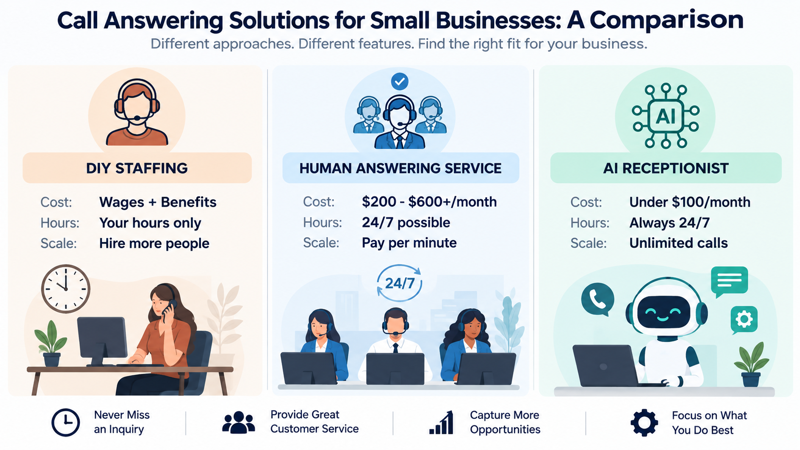
Customers don't always contact a business during office hours. A homeowner might discover an air-conditioning problem late at night. A property manager might request a plumbing estimate over the weekend. A potential client might send a message while your team is busy serving someone else.
How your business handles those inquiries can determine whether they become opportunities—or disappear into a competitor's inbox.
AI receptionists, human answering services, and traditional voicemail offer different approaches to customer communication. Choosing the right one requires more than comparing subscription prices.
The important questions are: What happens when a customer reaches out? How quickly does someone respond? What information gets collected? And how much work remains for your employees?
What Is an AI Receptionist?
An AI receptionist is software that helps businesses handle incoming customer communications automatically.
Depending on the platform, it may answer telephone calls, exchange text messages, qualify leads, collect service details, schedule appointments, or transfer conversations to employees.
Not every AI receptionist provides all these capabilities.
Some focus primarily on conversational voice answering. Others specialize in SMS, customer intake, or business workflow automation.
For example, Zeerek Service focuses on AI-assisted SMS/MMS conversations, customer qualification, image understanding, and organizing service inquiries. Its current voice capabilities include keypad-based consent collection and call forwarding, rather than live conversational AI voice answering.
Understanding these differences prevents businesses from paying for features they don't need—or assuming a product can do something it cannot.
AI Receptionist vs. Human Answering Service vs. Voicemail
Each option has advantages.
Capability | AI-powered service | Human answering service | Traditional voicemail |
|---|---|---|---|
After-hours availability | Often 24/7 | Depends on provider | Yes |
Immediate interaction | Often | Depends on staffing | Recorded greeting |
Customer qualification | Configurable | Staff-dependent | Usually manual |
SMS conversations | Platform-dependent | Provider-dependent | Usually not included |
Image understanding | Available on some platforms | Generally manual | Not typical |
Appointment handling | Platform-dependent | Provider-dependent | Requires follow-up |
Human judgment | Limited; escalation needed | Stronger for complex situations | Requires callback |
Pricing | Subscription and usage-based | Often call/time-based | Usually inexpensive |
The right solution depends on the business.
A company handling sensitive, complicated conversations may benefit from human receptionists. A small business that primarily needs to capture customer information quickly may find AI-powered messaging particularly useful.
Many businesses benefit from combining automation with human oversight.
Seven Features to Compare Before Choosing
1. Availability outside business hours
Customers don't always wait until morning.
Look for a solution that can handle supported communications during evenings, weekends, and holidays.
Also distinguish between a system being technically available 24/7 and the business itself being available to provide service.
An AI system can collect a request at midnight without promising that a technician will arrive immediately.
2. Natural customer conversations
Rigid forms and keyword-only chatbots can frustrate customers.
Modern AI systems can interpret ordinary language, including incomplete sentences, spelling mistakes, and multiple details supplied in one message.
For example:
"My AC isn't cooling, it's about 12 years old, and I'm available tomorrow afternoon."
A capable system should recognize the service problem, equipment age, and preferred discussion time without forcing the customer to repeat information unnecessarily.
3. Lead qualification
A useful receptionist should do more than acknowledge an inquiry.
It should collect information that helps employees decide what to do next.
For a home-service business, that might include:
Type of service requested.
Description of the problem.
Customer contact information.
Service location.
Urgency.
Preferred appointment or discussion time.
This information can help employees prioritize and respond more efficiently.
4. Text messaging and image support
Telephone calls aren't always the most convenient communication channel.
Customers may prefer texting while working, traveling, or managing other responsibilities.
For HVAC, plumbing, appliance repair, and similar businesses, photographs can provide additional context.
A customer might send a picture of a leaking pipe, damaged fixture, or equipment label.
An AI system with image understanding can help interpret visible details, although visual observations should not be treated as a definitive technical diagnosis.
5. Human handoff
AI should not be expected to resolve every situation.
A customer might request an employee, raise a sensitive issue, or describe something requiring professional judgment.
A well-designed system should recognize when human attention is appropriate and preserve the relevant conversation information.
Automation should support employees, not prevent customers from reaching them.
6. Business workflow integration
Customer communication is only the beginning.
Consider what happens after information has been collected.
Can employees review the inquiry? Is the customer's information organized? Can the business manage follow-up activities without copying messages into separate spreadsheets?
For many businesses, a connected customer workspace can be more useful than a standalone answering tool.
7. Transparent pricing and usage limits
AI receptionist pricing can vary significantly.
Some services charge by call, some by voice minute, and others by unique customer or messaging volume.
Before subscribing, ask:
What usage is included each month?
Are SMS and MMS charged separately?
What happens when the allowance is exhausted?
Are additional charges automatic?
Are there setup or cancellation fees?
Does a higher plan unlock features or simply provide more capacity?
A low advertised subscription price isn't necessarily the lowest total operating cost.
How Zeerek Service Approaches Customer Communication
Zeerek Service is designed to help service businesses manage inquiries through AI-powered messaging and structured business workflows.
Its capabilities include:
AI-assisted SMS/MMS communication: Customers can describe their needs through text, with supported image understanding.
Customer qualification: The system helps collect relevant service details and organize requests.
Business-specific context: Conversations can use configured service categories, business information, and qualification requirements.
Human handoff: Employees can take over conversations that need personal attention.
Customer and request management: Information can be organized into business records for staff review and follow-up.
Voice forwarding: Incoming calls can be routed to the business through the configured telephone workflow.
Unlike systems that advertise live AI voice conversations, Zeerek Service's current AI interaction is messaging-based.
This distinction matters when comparing platforms fairly.
Which Option Is Best for Your Business?
Choose traditional voicemail when communication volume is low, immediate interaction is unnecessary, and your team can reliably return calls.
Consider a human answering service when personal conversation, nuanced judgment, or live telephone support is central to your customer experience.
Consider a conversational AI voice receptionist when your primary requirement is automated spoken interaction with incoming callers.
Consider AI-powered messaging and workflow automation when customers frequently text, share photos, request estimates, or need their information collected and organized before employees follow up.
The best choice is not necessarily the platform with the longest feature list.
It is the one that handles your actual customer communication needs reliably, transparently, and at a sustainable cost.
Questions to Ask During a Demo
Before committing to a service, test it using realistic situations.
Send an incomplete customer inquiry. Correct a detail midway through the conversation. Ask for a human employee. Submit multiple requests from the same contact. Test how the system behaves outside business hours.
Also review what employees actually see afterward.
An impressive AI conversation has limited business value if important information never reaches the people responsible for serving the customer.
Final Thoughts
AI-powered customer communication can help small businesses respond more consistently, reduce repetitive administrative work, and organize incoming opportunities.
But automation is most valuable when it fits the company's existing operations.
Compare actual capabilities, not just marketing terminology. Understand usage limits. Verify how human handoff works. And test the system before relying on it for customer communications.
Want to explore AI-assisted messaging and customer qualification for your business?
Visit Zeerek Service to learn how its communication and workflow tools are designed to support service businesses.