AI Text Messaging for Small Businesses: A Complete Guide
Discover how AI-powered SMS and MMS can help small businesses respond to inquiries, qualify leads, and organize customer communications.
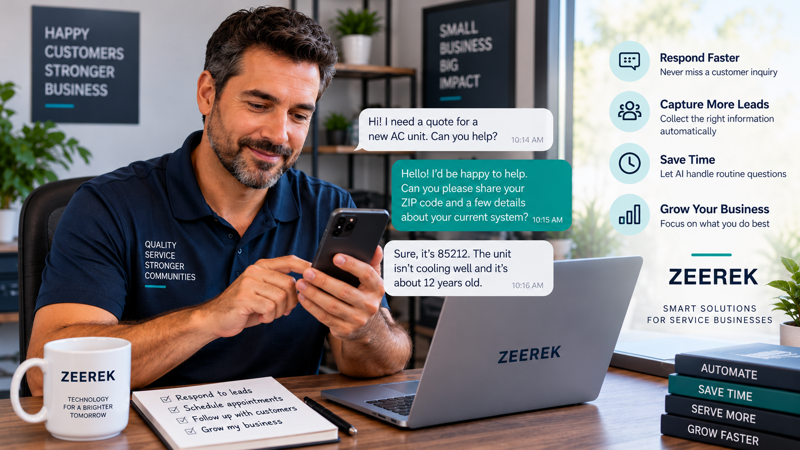
Customers expect businesses to respond quickly, clearly, and conveniently. Whether someone needs a plumbing repair, an HVAC estimate, an appointment, or an answer to a simple question, waiting hours for a response can be frustrating.
For small businesses, providing timely communication is not always easy. Owners may be serving customers, technicians may be working in the field, and office employees may be handling several responsibilities simultaneously.
AI text messaging offers a practical way to manage these conversations without requiring someone to manually respond to every inquiry.
But what exactly is AI text messaging, how does it work, and when is it worth implementing?
This guide explains the technology, its benefits, limitations, costs, and the practical steps businesses should consider before adopting it.
What Is AI Text Messaging?
AI text messaging combines conventional SMS or MMS communication with artificial intelligence capable of understanding and responding to natural-language messages.
Unlike traditional automated texting, which often follows predefined rules, an AI-assisted system can interpret a customer's question and respond based on the conversation and the business information it has been authorized to use.
For example, consider a customer contacting an HVAC company.
Customer: "My air conditioner stopped cooling this afternoon. Can someone come tomorrow?"
AI assistant: "I can help collect the details for a service request. What ZIP code is the property located in?"
Customer: "85212."
AI assistant: "Thank you. Could you describe what the system is doing? I'll include that information with your request for the team to review."
The system can collect relevant information and organize it for human follow-up.
Importantly, creating a service request is not the same as confirming an appointment. A responsible system should never promise a technician's availability without verified scheduling information.
AI Text Messaging vs. Traditional SMS Automation
Traditional SMS automation is useful for predictable interactions.
For example, a business might automatically send an appointment reminder or confirmation using a fixed message template.
AI text messaging extends that functionality by interpreting more varied customer responses.
Capability | Traditional SMS automation | AI-assisted messaging |
|---|---|---|
Scheduled reminders | Yes | Yes, when configured |
Fixed keyword responses | Yes | Yes |
Natural-language questions | Limited | More flexible |
Multi-message conversations | Rule-dependent | Context-aware |
Collecting service details | Predefined forms or scripts | Conversational intake |
Handling unusual questions | Often requires fallback rules | Can interpret more situations, with safeguards |
Human escalation | When configured | When configured |
Neither approach is automatically superior.
Traditional automation may be more economical for simple reminders, while AI-assisted messaging can be more useful when customers ask unpredictable questions.
Many businesses benefit from combining both approaches.
Seven Ways Small Businesses Can Benefit From AI Text Messaging
1. Respond to Customer Inquiries More Consistently
Small business employees cannot always answer every incoming message immediately.
An appropriately configured AI assistant can respond to supported inquiries, ask follow-up questions, and gather information while employees are occupied.
This helps prevent routine inquiries from sitting unattended.
2. Capture More Complete Lead Information
A message saying "I need help with my furnace" provides little information for scheduling or estimating work.
AI-assisted intake can ask for relevant details, such as:
Customer name and contact information.
Type of service requested.
Location or service area.
Description of the problem.
Preferred callback or appointment window.
Urgency and relevant circumstances.
This gives employees a more useful starting point when following up.
3. Support After-Hours Communication
Customers may contact businesses during evenings, weekends, or holidays.
AI-assisted messaging can help acknowledge supported inquiries and collect information outside normal office hours.
However, businesses must clearly communicate when human assistance is available.
Automated messaging should not imply that an emergency technician has been dispatched or an appointment confirmed unless that action actually occurred.
4. Reduce Repetitive Administrative Work
Employees frequently answer similar questions:
What areas do you serve?
What are your business hours?
Do you handle this type of repair?
How can I request an appointment?
When will someone contact me?
When the business supplies accurate information, an AI assistant can help handle supported routine questions and direct more complicated matters to staff.
5. Organize Customer Conversations
A useful messaging platform should do more than send replies.
It should help businesses understand what customers need, preserve relevant conversation history, and associate inquiries with service requests or customer records.
This reduces the risk of important information being scattered across personal phones, notebooks, and separate inboxes.
6. Improve Human Follow-Up
AI is not a replacement for personal customer service.
A well-designed system helps employees take over when a situation requires judgment, technical expertise, or direct customer attention.
For example, a complaint, unusual scheduling request, or safety concern may require human intervention.
The goal is to make that handoff clearer and more efficient.
7. Support Growth Without Immediately Expanding Administrative Staffing
As inquiry volume increases, small businesses may struggle to keep up with customer communication.
AI-assisted messaging can help handle some routine interactions without requiring proportional increases in administrative work.
Actual savings depend on message volume, system costs, staff involvement, and the quality of the implementation.
Which Businesses Can Benefit Most?
AI text messaging can be particularly useful for service businesses receiving recurring customer inquiries.
HVAC Contractors
HVAC companies can collect information about heating and cooling problems, service locations, and preferred callback windows.
Plumbing Companies
Plumbers can organize requests involving leaks, drains, water heaters, and other service needs, while routing urgent matters for human attention.
Electrical Contractors
Electrical businesses can gather initial service details and direct potentially hazardous situations to qualified personnel.
Cleaning Services
Cleaning businesses can collect property details, requested services, and preferred dates before preparing estimates or scheduling visits.
Landscaping Companies
Landscaping providers can gather information about property size, maintenance needs, and requested services.
Other Service Industries
Garage door companies, pest control businesses, appliance repair providers, roofers, painters, and similar contractors can also benefit from structured inquiry management.
The right configuration should reflect the actual services, operating hours, service areas, and business policies of each company.
How Does AI Text Messaging Work?
Although implementations differ, a typical workflow involves several steps.
Step 1: A customer contacts the business.
The customer sends an SMS or MMS message to a business number, or enters an approved messaging workflow following another interaction.
Step 2: The system checks messaging eligibility.
Before sending an automated response, the system should apply applicable consent, opt-out, and communication rules.
Step 3: AI interprets the inquiry.
The system evaluates the customer's message using relevant business information and configured instructions.
Step 4: The conversation collects useful details.
The assistant may ask questions needed to understand the service request.
Step 5: Information is organized.
The platform can associate the conversation with customer records or a structured service request.
Step 6: Human staff review or take over.
Employees can respond, make scheduling decisions, or handle situations outside the system's approved capabilities.
The most reliable implementations maintain clear boundaries between automated assistance and actions requiring human authorization.
Is AI Text Messaging the Same as an AI Receptionist?
Not necessarily.
The phrase "AI receptionist" can describe several different technologies.
Some products answer telephone calls with conversational AI voice agents. Others focus on text messaging, missed-call follow-up, call forwarding, or customer intake.
These distinctions matter.
A business evaluating a solution should ask:
Does the AI actually speak with callers in real time?
Does it respond through SMS or MMS?
Does it forward calls to employees?
Can it create service requests?
Does it confirm appointments or merely collect scheduling preferences?
How does it handle emergencies and human escalation?
Understanding the actual capabilities helps prevent purchasing a system that does not match the business's needs.
What Does AI Text Messaging Cost?
Pricing varies depending on the platform and the services included.
Common cost components include:
Subscription fees: Monthly charges for access to the software and its included capacity.
SMS usage: Text messaging is often measured in segments rather than simply counting visible messages. Longer messages may consume multiple segments.
MMS usage: Messages containing supported media may have different charges from ordinary SMS.
AI processing: AI systems may measure processing through tokens or other usage units.
Phone numbers and carrier fees: Business telephone numbers, messaging registration, and carrier-related expenses can contribute to overall costs.
Additional usage: Some services charge for consumption beyond the included subscription allowances.
Businesses should compare not just subscription prices but also included usage, additional charges, cancellation terms, and available spending controls.
The most economical option depends on actual customer activity rather than advertised maximum capacity alone.
What About Customer Consent and Messaging Compliance?
This is one of the most important considerations.
Businesses should not assume that possessing a customer's phone number automatically authorizes unlimited automated messaging.
Requirements vary depending on whether messages are conversational, informational, or promotional.
For example, a customer who initiates a text conversation may permit a response related to that inquiry, but that does not automatically authorize an ongoing marketing campaign.
Businesses should establish appropriate consent procedures, identify themselves clearly, maintain required records, and honor opt-out requests.
For US business messaging, registration and carrier requirements may also apply.
Twilio's Messaging Policy and A2P 10DLC guidance provide useful explanations of consent, campaign registration, and opt-out expectations.
A messaging platform should support compliance, but using software does not eliminate the business's legal responsibilities.
Five Questions to Ask Before Choosing an AI Messaging Platform
1. Can the System Use Our Actual Business Information?
The assistant should rely on accurate services, coverage areas, operating hours, and business policies rather than inventing answers.
2. Can Employees Take Over Conversations?
Human intervention should be available for situations requiring personal attention or professional judgment.
3. How Are Usage Limits Managed?
Businesses should understand included allowances, warning thresholds, additional charges, and what happens when limits are reached.
4. Does the Platform Protect Customer Information?
Look for appropriate access controls, tenant separation, data protection, and clearly defined retention policies.
5. Can We Measure Results?
Useful metrics include inquiry volume, response time, qualified service requests, completed bookings, and customer outcomes.
A platform should help businesses evaluate whether the technology delivers practical value.
Introducing Zeerek Service
Zeerek Service is an AI-assisted customer communication and service-request management platform designed for service businesses.
Its capabilities include conversational SMS/MMS assistance, customer inquiry qualification, structured service requests, configurable business information, usage visibility, and human follow-up workflows.
Its current telephone architecture uses consent handling and call forwarding. It is not a live conversational AI voice receptionist.
Zeerek Service is designed to help businesses organize communication while maintaining human oversight and controlled usage.
Explore Zeerek Service's AI SMS Assistant:
https://zeerek.com/zeerek-service/ai-sms-assistant
Discover Zeerek Service features:
https://zeerek.com/zeerek-service/features
Frequently Asked Questions
Can AI respond to text messages automatically?
Yes. When properly configured and authorized, AI-assisted systems can interpret customer messages and generate appropriate responses based on available business information and messaging policies.
Can AI text messaging replace customer service employees?
It can assist with routine communication and information collection, but human employees remain important for complex situations, sensitive decisions, and customer relationships.
Does AI messaging work outside business hours?
It can, depending on the platform's configuration, communication eligibility, and operating policies. Human service availability should always be represented accurately.
Can customers send pictures through AI messaging?
Some platforms support MMS and image interpretation. The exact capabilities, supported formats, and usage charges depend on the provider.
Is AI text messaging expensive for small businesses?
Not necessarily. Costs depend on subscription pricing, message volume, AI usage, carrier charges, and administrative requirements. Businesses should evaluate expected usage and potential operational benefits.
Is AI text messaging suitable for every business?
No. Businesses with very low inquiry volume or highly specialized communication requirements may find simpler tools more appropriate. The decision should be based on actual operational needs.
Final Thoughts
AI text messaging can help small businesses respond more consistently, collect useful customer information, and organize service inquiries without sacrificing human oversight.
The greatest benefit is not simply sending automated replies. It is creating a reliable communication process that helps customers receive appropriate attention and gives employees the information they need to act.
For service businesses evaluating AI-assisted communication, the best starting point is to identify existing communication problems, establish clear operational goals, and choose technology that addresses those needs.
Want to explore AI-assisted messaging for your service business?
Learn how Zeerek Service can help organize customer inquiries, manage messaging conversations, and support human follow-up.
Explore Zeerek Service: https://zeerek.com/zeerek-service