How to Handle Customer Inquiries After Business Hours
Customers don't stop contacting your business when the office closes. Learn practical ways to capture after-hours inquiries, organize requests, and follow up without overloading your team.
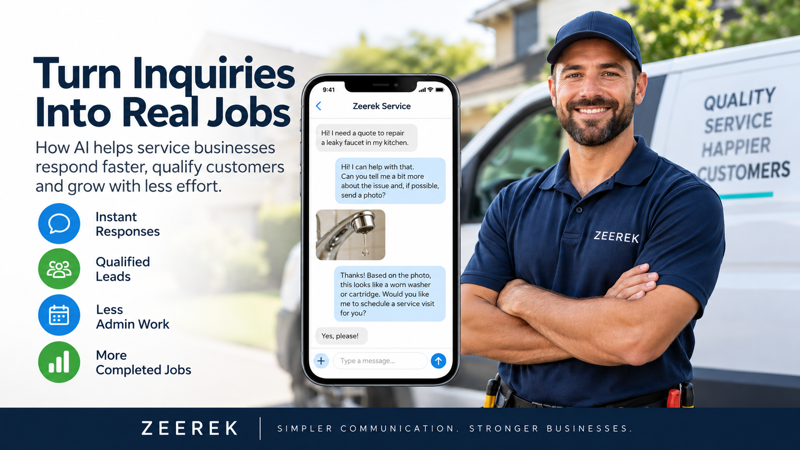
Customers do not stop needing help when a business closes for the day. A homeowner may discover a leaking pipe late at night, a property manager may request an HVAC repair over the weekend, or a prospective customer may ask for a service estimate after returning home from work.
For small service businesses, these inquiries present both an opportunity and a challenge. Responding around the clock with human staff can be expensive, but ignoring messages until the next morning may mean losing customers to competitors.
Fortunately, businesses can improve after-hours communication without promising immediate service or hiring a full overnight team.
The key is to establish a reliable process for receiving inquiries, collecting useful information, setting realistic expectations, and arranging appropriate human follow-up.
Why After-Hours Customer Communication Matters
Customers frequently contact businesses when it is convenient for them, not necessarily during the business's operating hours.
For service companies, that may include evenings, weekends, holidays, and periods of unusually high demand.
An unanswered inquiry can create several problems:
The customer does not know whether the business received the request.
Important service details may be missing when staff return.
Urgent situations may not receive appropriate escalation instructions.
Employees must spend additional time gathering information later.
The customer may contact another provider before receiving a response.
Not every unanswered inquiry results in a lost sale. Some customers wait, leave messages, or contact the business again.
Nevertheless, a consistent after-hours process can improve customer experience and help businesses recover opportunities that might otherwise be overlooked.
The Difference Between Being Available and Providing Immediate Service
One of the most important distinctions is the difference between accepting an inquiry and promising service.
A company may allow customers to submit requests 24 hours a day without operating a 24-hour dispatch department.
For example:
Appropriate response:
"Thank you for contacting us. We've received your service request and will have a team member review it during our next business hours."
Potentially misleading response:
"A technician is on the way," when no technician has actually been dispatched.
Businesses should make their availability and response commitments clear.
If emergency services are offered, the company should define how those requests are handled, who is responsible for responding, and what happens when staff are unavailable.
Seven Ways to Handle Customer Inquiries After Business Hours
1. Establish a Clear After-Hours Communication Policy
Start by deciding what happens when customers contact the business outside normal hours.
Your policy should answer:
Which communication channels are monitored?
Can customers submit requests at any time?
When should they expect a human response?
Are emergency services available?
Which situations require escalation?
Who reviews requests when the office reopens?
A written policy helps prevent inconsistent responses and unrealistic customer expectations.
2. Provide a Reliable Way to Capture Customer Information
An after-hours inquiry is more useful when it contains enough information for employees to act.
Depending on the business, collect:
Customer name.
Contact information.
Service address or ZIP code.
Type of service requested.
Description of the problem.
Preferred callback window.
Relevant urgency information.
Avoid requesting sensitive personal information that is unnecessary for the service.
For HVAC, plumbing, electrical, and other field-service businesses, structured intake can reduce repetitive follow-up questions.
3. Use Automated Acknowledgments Appropriately
An automated acknowledgment can reassure customers that their inquiry was received.
For example:
"Thank you for contacting ABC Heating & Cooling. Our office is currently closed. Please share your service address and a brief description of the issue. Our team will review your request when available."
Such messages should be accurate, identify the business, and comply with applicable messaging-consent requirements.
An acknowledgment is not a confirmed appointment or service guarantee.
4. Offer AI-Assisted Text Messaging
Traditional automated messages often provide a fixed response.
AI-assisted SMS and MMS systems can support more flexible conversations, helping customers describe their needs in ordinary language.
For example, a customer might text:
"My air conditioner is running, but it isn't cooling the house."
An AI assistant can ask for relevant information such as location, equipment type, and a description of the symptoms.
The collected details can then be organized into a service request for staff review.
This is especially useful for businesses receiving different kinds of inquiries that cannot be handled with one generic message.
However, AI should operate within defined business rules and escalate situations requiring professional judgment.
5. Create a Human Escalation Process
Automation should not leave customers without a path to human assistance.
Businesses should identify which inquiries require escalation, including:
Safety-related concerns.
Emergency service requests.
Complaints or disputes.
Complex scheduling issues.
Situations outside the system's approved capabilities.
For example, a customer reporting a suspected gas leak should not receive ordinary troubleshooting instructions from a messaging assistant.
The system should direct the customer toward appropriate emergency assistance and avoid implying that the business is monitoring or dispatching help unless that is actually true.
6. Organize Requests for the Next Business Day
Collecting messages is only part of the solution.
The business also needs a reliable way to review and act on them.
A useful follow-up process might include:
Reviewing new service requests.
Identifying urgent or time-sensitive inquiries.
Checking service-area eligibility.
Assigning requests to appropriate employees.
Contacting customers.
Recording outcomes.
A centralized view of customer inquiries can make this process more manageable than relying on scattered voicemail messages and personal text conversations.
7. Measure Results and Improve the Process
Track whether the after-hours system is helping customers and employees.
Useful measurements include:
Number of after-hours inquiries.
Percentage receiving acknowledgment.
Average time to human follow-up.
Number of qualified service requests.
Number of completed bookings.
Number of inquiries requiring escalation.
Customer complaints related to communication.
Cost per recovered service opportunity.
These measurements help businesses determine whether their process is producing real operational value.
How Different Service Businesses Can Apply These Strategies
HVAC Companies
Heating and cooling problems often arise outside normal office hours.
An HVAC company can collect equipment details, service locations, symptoms, and callback preferences.
Emergency availability should be stated clearly rather than assumed.
Plumbing Companies
Plumbing businesses may receive inquiries about leaks, clogged drains, water heaters, and urgent repairs.
A structured intake process can help identify the type of request and route time-sensitive situations appropriately.
Electrical Contractors
Electrical inquiries sometimes involve significant safety concerns.
Automation should avoid diagnosing hazardous electrical problems and direct potentially dangerous situations toward appropriate professional or emergency assistance.
Cleaning Services
Cleaning businesses can collect property details, requested cleaning services, preferred dates, and contact information.
Many of these requests can be organized for next-business-day follow-up.
Landscaping and Property Maintenance
Customers may request maintenance estimates, seasonal services, or property visits during evenings and weekends.
Automated intake can collect basic information without requiring immediate staff involvement.
After-Hours Answering Service vs. AI Messaging
Businesses considering better after-hours coverage often compare human answering services with automated messaging solutions.
Consideration | Human answering service | AI-assisted messaging |
|---|---|---|
Communication channel | Primarily voice | Primarily SMS/MMS |
Natural conversation | Human-operated | AI-generated within configured limits |
Information collection | Based on operator procedures | Based on business rules and AI workflows |
Human judgment | Directly available | Requires escalation |
Availability | Depends on provider coverage | Depends on system configuration and service availability |
Pricing | Often call-based or subscription-based | Often subscription and usage-based |
Best fit | Customers needing live human voice assistance | Businesses seeking conversational text intake and organized follow-up |
These approaches are not mutually exclusive.
Some businesses may benefit from combining call forwarding, human answering, and AI-assisted text messaging.
The right choice depends on customer preferences, inquiry volume, budget, and operational requirements.
How Zeerek Service Supports After-Hours Customer Inquiries
Zeerek Service is designed to help service businesses manage customer communication through AI-assisted SMS and MMS conversations, structured customer intake, service-request organization, and human follow-up workflows.
Businesses can configure information such as operating hours, services, coverage areas, and communication preferences.
Its telephone workflow uses consent handling and call forwarding. It does not currently provide a live conversational AI voice receptionist.
For an after-hours inquiry, supported AI messaging can help collect customer information and organize the request so employees have useful details when they follow up.
The business remains responsible for deciding whether emergency service is available, confirming appointments, and making service commitments.
Explore how Zeerek Service works:
https://zeerek.com/zeerek-service/how-it-works
Learn about AI-assisted customer messaging:
https://zeerek.com/zeerek-service/ai-sms-assistant
Common Mistakes to Avoid
Even well-intentioned automation can create problems when configured poorly.
Promising Immediate Help Without Staff Availability
Never claim that a person is monitoring an inquiry or that a technician has been dispatched unless those statements are true.
Asking Too Many Questions
Customers contacting a business after hours may be tired, stressed, or dealing with urgent problems.
Keep intake questions relevant and concise.
Ignoring Messaging Consent
Automated text messaging must respect applicable consent, identification, and opt-out requirements.
Failing to Review Collected Requests
Automation cannot improve customer service if nobody follows up on the information it collects.
Treating Every Inquiry as an Emergency
Not every request requires immediate escalation.
Clear business rules can help prioritize genuine urgency while keeping routine requests organized.
Frequently Asked Questions
Should a small business respond to customers 24/7?
Not necessarily with human staff. Many businesses can provide an around-the-clock way to submit inquiries while clearly explaining when employees will respond.
Can AI handle customer inquiries after hours?
Yes. AI-assisted messaging can collect information, answer supported questions, and organize requests when properly configured. Human assistance remains important for emergencies, complex situations, and service decisions.
Is an automated acknowledgment enough?
An acknowledgment helps confirm receipt, but the business still needs a dependable follow-up process.
Can after-hours AI messaging schedule appointments?
Capabilities vary. Some platforms integrate directly with calendars, while others collect appointment preferences or create requests that require staff confirmation.
How can a business measure the value of after-hours messaging?
Track qualified inquiries, follow-up times, completed bookings, customer outcomes, and the cost of operating the system. Compare results with the previous communication process.
Final Thoughts
Handling customer inquiries after business hours does not require promising immediate service or staffing an office around the clock.
It requires a clear communication policy, dependable inquiry collection, realistic customer expectations, and consistent follow-up.
AI-assisted messaging can support this process by helping businesses gather useful information and organize requests while employees focus on their primary responsibilities.
The most effective approach combines automation with human accountability, giving customers a convenient way to reach the business without creating promises the company cannot fulfill.
Want to improve how your business handles customer inquiries?
Explore Zeerek Service to learn how AI-assisted messaging and structured service-request workflows can support customer communication beyond traditional office hours.